
Ascot Lucky 15 Strategy: Multiple Bet Tips
 Available in US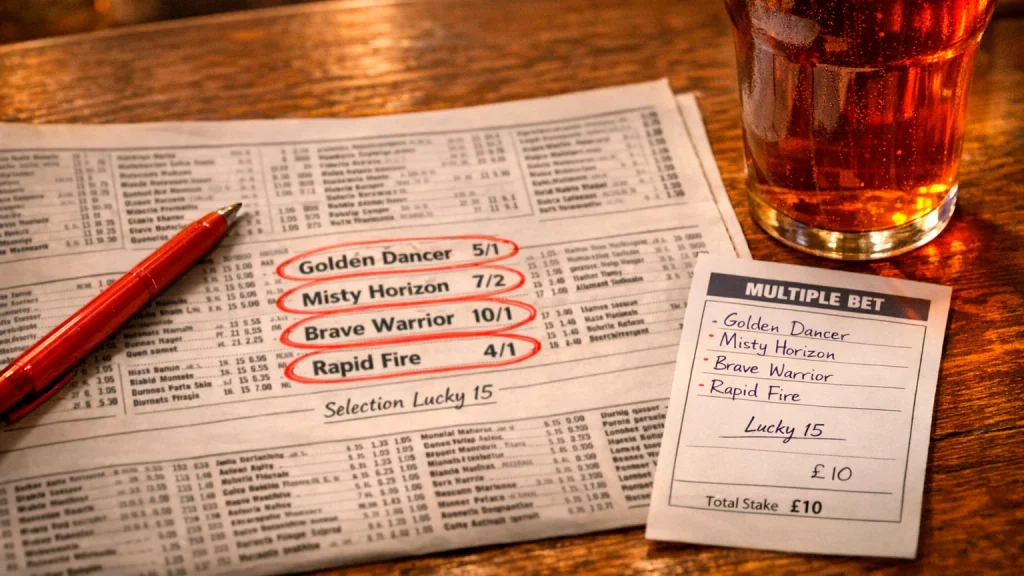
Ascot Lucky 15 betting combines four selections into fifteen bets, creating opportunities for returns even when not all picks win. The Lucky 15 structure—four singles, six doubles, four trebles, and one fourfold—means a single winner guarantees some return, while multiple winners produce escalating payouts. For Ascot meetings with competitive racing across the card, the Lucky 15 offers a way to maintain interest throughout the afternoon while managing downside risk.
The bet’s popularity reflects its recreational appeal: exciting accumulator potential alongside singles that protect against total loss. However, the mathematics deserves scrutiny. Fifteen separate bets require fifteen times your unit stake, and the structure favours bookmakers unless you find genuine value. This guide explains how Lucky 15s work, which bookmaker bonuses enhance value, selection criteria for Ascot cards, and how to apply the format specifically to Royal Ascot and other major meetings.
Ascot Lucky 15 Strategy — More on this topic at ascot betting tips.
How the Lucky 15 Works
A Lucky 15 combines four selections into fifteen bets: four singles on each horse individually, six doubles combining each pair, four trebles combining each trio, and one fourfold requiring all four winners. Your total stake is fifteen times your unit amount—a £1 Lucky 15 costs £15; a £2 Lucky 15 costs £30. Returns depend on which horses win and at what prices.
The singles provide insurance against complete loss. If only one horse wins, that single pays out regardless of what happens in the doubles, trebles, and fourfold. At typical odds, one winner from four might return roughly 30-50 percent of total stake—a loss, but not total wipeout. Two winners activate one double alongside two singles; three winners activate three doubles, one treble, and three singles. Four winners complete the fourfold for maximum returns.
Understanding compound returns clarifies payout expectations. If all four horses win at 3/1 each, a £1 Lucky 15 returns approximately £512 before any bonuses—dramatic but requiring everything to land. Three winners at the same prices return roughly £80; two winners around £20; one winner perhaps £4. The distribution rewards multiple winners disproportionately while singles merely cushion single-winner disappointment.
Calculating returns manually is tedious; online calculators simplify the process. Enter your four selections’ odds and unit stake to see potential returns for each outcome scenario. These tools help determine whether the Lucky 15’s structure suits your selections: high-priced horses offer more upside but lower probability; shorter prices provide steadier but smaller returns. Balance the portfolio according to your risk appetite.
Bookmaker Bonuses and Promotions
Lucky 15 bonuses significantly affect expected value. Most bookmakers offer consolation bonuses when only one selection wins: typically double the odds on that single, transforming a modest return into a more meaningful recovery. Some operators extend this to 10% bonus on all four winners or 25% if they are all different races. These bonuses exist because the Lucky 15’s recreational appeal attracts casual bettors; serious punters can exploit them.
The UK’s regulated betting market ensures these bonuses operate transparently. According to IBIA and H2GC research, UK onshore channelisation in sports betting stands at 97 percent—meaning virtually all betting occurs through licensed operators whose promotional terms must be clear and enforceable. When a bookmaker advertises Lucky 15 bonuses, you can trust they will be honoured as stated.
Felicity Barnard, Ascot’s CEO, reflected on the track’s commercial success when discussing 2024 results: “We were delighted to see continued revenue growth in 2024, reaching record levels of more than £113.1m.” Her remarks, shared through TDN’s coverage, underscore the betting volumes that major meetings generate. This activity supports bookmaker promotions including Lucky 15 bonuses, as operators compete for the recreational betting market that Ascot meetings attract.
Comparing bonus structures across bookmakers identifies the best value for Lucky 15s. One operator might offer double odds on a single winner while another offers treble odds; one might pay 10% bonus for four winners while another pays 25%. Check terms before placing bets, concentrating stakes where bonuses most enhance expected returns. The basic bet structure is identical everywhere; bonus generosity varies significantly.
Selection Criteria
Lucky 15 success requires balancing probability against price. Four odds-on favourites might frequently produce multiple winners but at prices too short to generate meaningful returns. Four 20/1 outsiders offer huge potential payouts but rarely deliver even one winner. The optimal approach targets horses at mid-range prices—perhaps 3/1 to 8/1—where probability and reward intersect favourably.
Understanding favourite strike rates informs this balance. Research from industry analysis shows that favourites in British racing win approximately 30 to 35 percent of races. This means backing four favourites gives roughly 1-2 expected winners—enough for some return via singles and possibly a double, but unlikely to activate the higher-paying combinations. Mixing favourites with longer-priced selections adds upside without abandoning probability entirely.
Race selection matters alongside horse selection. Choosing four horses from races with different dynamics—perhaps a competitive handicap, a conditions race, a juvenile event, and a Group contest—spreads risk across race types. If one category proves challenging on the day—say, handicaps produce surprising results—your selections in other race types might still deliver. Avoid four selections from similar race types that might all fail for connected reasons.
Form confidence should drive selection, not just price attractiveness. Including a 12/1 shot because “it would be nice if it won” dilutes expected value unless you genuinely believe the price underestimates the horse’s chance. Every selection in your Lucky 15 should represent a standalone betting proposition you would consider backing individually. The multiple bet structure aggregates value; it cannot create value from poor selections.
Lucky 15 for Ascot Cards
Ascot meetings typically offer seven or eight races, providing ample selection opportunities for Lucky 15 construction. You need only four selections from the card, allowing you to pass on races without compelling picks. This selectivity improves expected value: rather than forcing selections into difficult races, wait for races where your analysis identifies genuine value.
See also Ascot Accumulators.
Royal Ascot’s daily structure suggests natural Lucky 15 approaches. Each day features Group races alongside heritage handicaps, creating diversity that suits mixed selection strategies. You might target a strongly fancied runner in a conditions race, a value play in a handicap, an each-way type in a competitive sprint, and a class act in a Group contest. The variety across a Royal Ascot day supports balanced portfolios.
Timing your Lucky 15 requires consideration of race schedules. If your four selections run across widely spaced races, you experience extended anticipation—exciting for some, stressful for others. If selections cluster in consecutive races, the outcome resolves quickly. Neither approach affects expected value, but personal preference might guide how you structure selections across the card.
Single-day Lucky 15s work best when racing conditions remain consistent throughout. If ground is expected to change significantly—morning rain followed by afternoon drying, for example—selections made before racing might face different conditions than anticipated. Either adjust selections as conditions clarify or accept that weather uncertainty adds an extra variable to your Lucky 15’s outcome.
Consider spreading Lucky 15s across multiple Ascot meetings rather than concentrating on single days. A selection from the King George meeting, one from a summer fixture, one from Champions Day, and one from Royal Ascot diversifies timing risk and allows you to target peak confidence selections across the calendar. This approach sacrifices same-day excitement for potentially better-calibrated selection quality across months of racing.
