
Ascot Handicap Betting Strategy: Tactics for Big-Field Racing
 Available in US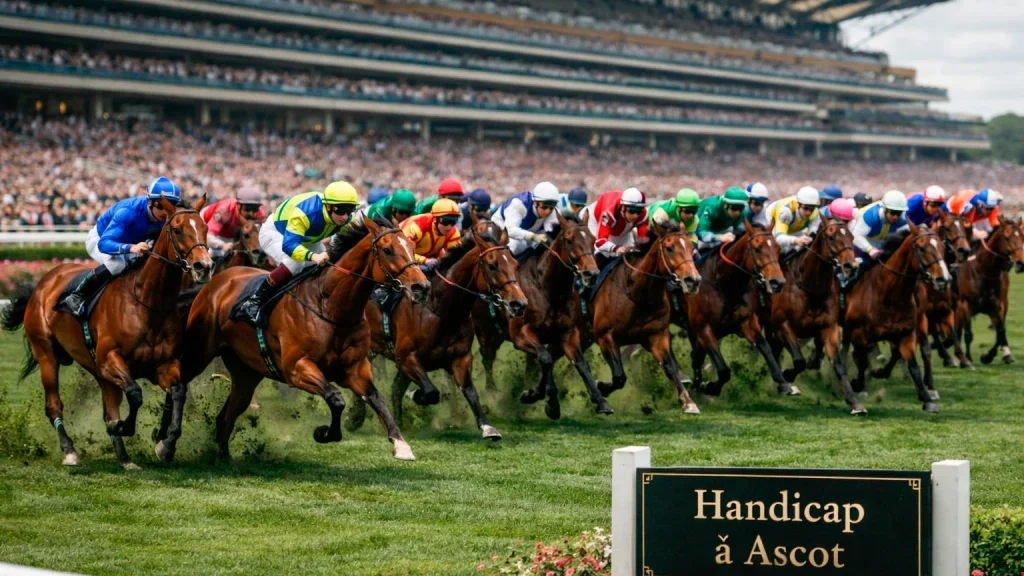
Ascot handicap betting strategy differs fundamentally from approaches that work in smaller fields. The heritage handicaps at Royal Ascot—Royal Hunt Cup, Wokingham Stakes, Britannia—feature 25 to 30 runners competing for substantial prizes. These races demand specific analytical methods that casual punters rarely apply systematically.
What makes handicap betting at Ascot compelling is the paradox at its core: these races are harder to predict yet more rewarding when you get them right. The large fields create genuine pricing inefficiency. The market cannot accurately assess 28 horses with the precision it applies to a six-runner Group 1, and this difficulty creates opportunity for bettors who approach the puzzle methodically.
The big-field betting blueprint requires multiple analytical layers: pace assessment, draw consideration, trainer patterns, and each-way value calculation. No single factor determines outcomes in competitive handicaps. Success comes from weighting these factors appropriately and identifying horses where multiple positive indicators converge. This analysis provides the framework for that systematic approach.
Understanding why handicaps differ from other race types provides essential context. In conditions races and Group events, class determines outcomes—the better horse wins. In handicaps, the weights attempt to equalise class, making other factors decisive. Pace dynamics, draw position, ground preference, and race fitness all gain magnified importance when raw ability is theoretically neutralised. This shift in what matters reshapes how smart punters assess runners.
Ascot Handicap Betting Strategy — More on this topic at ascot betting tips.
How Handicap Racing Works
Handicap races attempt to create competitive betting events by assigning weights that theoretically equalise every runner’s chance. The British Horseracing Authority employs handicappers who assess each horse’s ability through official ratings, then translate those ratings into weight assignments. Higher-rated horses carry more weight; lower-rated horses carry less. The goal is a finish where any horse might win.
The official rating scale runs from low figures for modest performers to 115+ for elite handicappers. At Ascot, the heritage handicaps typically attract horses rated between 95 and 110, though conditions vary by race. The weight range might span 10 to 15 pounds from top weight to bottom weight, a spread that significantly affects race dynamics.
Understanding the rating system helps bettors identify horses who might outperform their mark. A horse that has improved since its last race might be “well handicapped”—assigned a rating below its current ability. Conversely, a horse dropping in form carries a rating based on past performance that no longer reflects present capability. This gap between official rating and actual ability creates the margins that successful handicap betting exploits.
Weight-for-age allowances add complexity. Three-year-old horses receive weight allowances when competing against older horses, reflecting typical maturity differences. At certain times of year, these allowances favour younger horses; at others, the balance shifts. Understanding where the weight-for-age advantage lies for specific Ascot handicaps helps identify runners positioned to outperform expectations.
The practical implication for bettors is recognising that handicaps are not lotteries despite their competitive fields. Horses carry different chances based on whether they’re racing off accurate ratings, improving or declining, and whether race conditions suit their profiles. The randomness is real but not total—skilled assessment still outperforms guesswork.
The handicapper’s role itself deserves understanding. These officials watch racing, study form, and adjust ratings after every run. A horse that wins impressively sees its rating rise; one that disappoints sees it fall. The system aims to make every horse 0% likely to win, but imperfections persist—human judgment cannot perfectly capture equine ability, and this imperfection creates the edges bettors seek.
The Favourite Paradox in Handicap Races
Handicap races present a statistical pattern that contradicts intuition. Favourites in handicap races win approximately 39% of the time, compared to just 26% in non-handicap races. This counter-intuitive result—favourites winning more often in races designed to create level fields—reveals something important about market efficiency.
The explanation lies in how the market processes information. In handicaps, the betting public collectively identifies horses with profile advantages: progressive types, well-handicapped improvers, horses suited by conditions. This collective intelligence concentrates support on genuinely superior propositions more effectively than official ratings alone can capture. The favourite in a competitive handicap isn’t arbitrary; it reflects aggregated judgement about which horse holds edge despite the weights.
Second favourites provide another exploitable pattern. The second-favoured horse wins approximately 18-21% of handicap races, a figure that creates specific betting approaches. When the favourite appears vulnerable—wrong ground, poor draw, questionable form—the second favourite often represents the market’s backup assessment and merits consideration as an alternative.
For bettors, these statistics inform rather than dictate strategy. Backing every handicap favourite produces poor returns because the prices don’t compensate for the losers. The 39% win rate sounds impressive until you recognise that most handicap favourites start at odds that imply higher win probabilities. Value exists when the favourite’s actual chances exceed the implied probability of available odds.
The numbers also highlight when opposing favourites makes sense. If a handicap favourite’s price implies 50% win probability but empirical rates suggest 39%, that favourite may be overbet. Identifying these situations—where market confidence exceeds statistical expectation—creates opportunities either to oppose or to find value in alternatives.
Large-field handicaps at Ascot represent the extreme case of this dynamic. With 25+ runners, even the strongest favourite rarely exceeds 30% actual win probability. The market sometimes prices favourites as if they were competing in smaller fields, creating systematic value in the place portions of each-way bets or in backing horses at longer odds whose chances the market has underestimated.
Ascot’s Heritage Handicaps: The Main Events
Three heritage handicaps anchor Royal Ascot’s betting interest: the Royal Hunt Cup, the Wokingham Stakes, and the Britannia Stakes. These races combine history, prize money, and field sizes that create the ultimate handicap betting tests. Understanding each race’s specific characteristics helps target appropriate runners.
The Royal Hunt Cup runs over one mile on the straight course, typically attracting around 30 runners chasing a six-figure prize. This race favours horses with tactical versatility—the ability to race prominently or come from behind depending on how the race unfolds. The straight mile configuration means draw position matters less than pace judgment; where you race matters more than where you start. Historical winners have emerged from across the draw, confirming that a bad stall isn’t disqualifying at this distance.
The Wokingham Stakes, a six-furlong sprint, tests speed and handling of large-field chaos. With 28 runners typical, this race produces dramatic finishes where horses emerge from clusters to win by heads and short-heads. The sprint distance places premium on early positioning, making draw assessment more relevant than in the Hunt Cup. Horses drawn on the favoured side of the track gain measurable advantage, particularly when ground conditions create bias.
The Britannia Stakes restricts entry to three-year-olds over the straight mile, identifying the best handicappers among the Classic generation. This race often features progressive types stepping up from lesser company, and the age restriction means all runners carry the same weight-for-age terms. Form lines from earlier in the season guide assessment, though improvement curves for three-year-olds make projections challenging. Trainers frequently target this race with lightly raced horses whose ability might exceed their current rating.
Prize money at these events justifies serious competition. When trainers can target races worth over £100,000, they prepare horses specifically for the task. This targeting creates informed betting opportunities: horses entered months in advance and trained with particular races in mind represent genuine attempts rather than speculative entries.
The heritage handicap schedule also creates form lines for later assessment. A horse that runs well in the Royal Hunt Cup might reappear at Goodwood or York, carrying evidence of Ascot ability that informs future betting. Similarly, disappointing runs at Royal Ascot often reflect race conditions rather than fundamental inability, knowledge applicable when circumstances change.
Beyond the big three, Ascot hosts numerous supporting handicaps during Royal week that offer similar characteristics at slightly reduced scale. The Duke of Edinburgh Stakes, the Golden Gates Handicap, and various other events attract deep fields and present analogous betting challenges. The principles that guide assessment of heritage handicaps apply equally to these valuable supporting races.
Tactical Analysis for Large Fields
Large-field handicaps amplify the importance of race dynamics that smaller fields minimise. According to analysis citing British Horseracing Authority handicappers, approximately 40% of results that appear to defy form can be explained through pace analysis. In big-field handicaps, this percentage likely rises—the chaos of 28 horses creates pace scenarios impossible to predict perfectly but possible to assess probabilistically.
Front-running horses face particular challenges in large fields. The competition for early position intensifies, with multiple speed horses vying for the lead. This often produces faster early fractions than smaller fields would generate, burning off pace horses and favouring those racing mid-pack or behind. Identifying which horses want to lead, and how many of them are present, helps predict whether the race will suit front-runners or closers.
Hold-up horses benefit when pace is strong but face risks when it collapses. If the field goes slowly early, horses racing from behind find themselves with too much ground to make up. The shape of the race—fast, slow, or steady—determines which running styles prove advantageous. Anticipating this shape, based on the composition of runners, provides tactical edge.
Sectional timing data, where available, offers insights into how horses have finished previous races. A horse that accelerated in the final furlong of its last start demonstrated the ability to quicken, a crucial trait when races compress in the final stages. Conversely, a horse that slowed late might struggle when the finishing challenges intensify.
The handicap assessment begins with pace analysis: identify the likely leaders, estimate the probable tempo, and select horses whose running styles match the expected race shape. This isn’t prediction with certainty but probability with edge—small advantages that compound across a betting portfolio.
Traffic problems represent the other major large-field factor. Horses racing in midfield must navigate through clusters of runners to reach clear ground. Some horses handle this manoeuvring better than others; some jockeys excel at finding gaps. Course form demonstrating big-field competence provides evidence that a horse can handle the specific demands these races present.
Jockey choice amplifies in importance when traffic management determines placings. Riders with experience of large-field Ascot handicaps understand where gaps typically appear, when to commit to runs, and how to balance aggression against patience. The jockey’s record in these specific races provides information beyond general strike rate.
Draw Considerations in Handicap Races
Draw position matters more in large-field handicaps than in smaller races because positional disadvantages become harder to overcome when 28 runners compete for the same space. The detailed analysis of Ascot’s draw characteristics applies with particular force here, but handicap-specific considerations modify general principles.
Sprint handicaps show the strongest draw effects. The Wokingham, contested over six furlongs, presents situations where draw position can eliminate horses from consideration regardless of form. When ground conditions create bias—typically towards the stands’ side when soft—horses drawn on the unfavoured side face genuine disadvantage. Monitoring conditions and adjusting draw expectations accordingly separates informed assessment from hopeful punting.
The mile handicaps, including the Royal Hunt Cup and Britannia, show weaker but still relevant draw patterns. The additional distance provides time for horses to overcome poor draws, but the advantage for well-drawn runners persists. In competitive races where margins are small, any advantage matters—draw position contributes to the cumulative edge that determines results.
Large-field dynamics create draw clusters: groups of runners drawn together who effectively race against each other before competing with the wider field. Horses drawn in poorly positioned clusters face compounded disadvantage. Studying where leading contenders are drawn, and whether they’ll compete against each other or have clear runs, adds sophistication to draw analysis.
The practical application involves treating draw as one factor among several rather than a decisive filter. A horse with excellent form drawn poorly remains a contender; a moderate horse drawn well doesn’t become a selection. The weighting depends on race specifics: sprint handicaps warrant heavy draw emphasis; mile handicaps warrant moderate attention; staying handicaps warrant minimal consideration.
Checking the going report on the day adds essential context. Even in races where historical draw patterns suggest neutrality, current conditions might create temporary bias. If earlier races on the card show winners consistently emerging from particular stall regions, that real-time information trumps statistical generalisation.
Trainers Who Target Handicaps
Certain trainers approach handicap racing as a speciality, developing methods that produce results in competitive races. The Gosdens’ five winners at Royal Ascot 2025, including handicap success, demonstrate how elite operations target the full programme. Understanding which trainers specialise in handicaps, and which avoid them, helps calibrate expectations.
Richard Fahey has built a reputation for targeting big-field handicaps at major meetings. His Northern operation prepares horses specifically for these challenges, with an understanding of pace dynamics and draw advantages that translates into results. Fahey runners in sprint handicaps merit automatic attention, their trainer’s specialisation providing edge that offsets distance from Southern tracks.
David O’Meara represents another handicap specialist whose Ascot record warrants respect. O’Meara runners arrive at the Royal Meeting trained with specific races in mind, their preparation reflecting the detailed targeting that competitive handicaps require. His success rate in these races exceeds what his general profile might suggest.
“Trainers will certainly appreciate the extra flexibility that converting these Group 2s to becoming normal closers offers. This will allow for more informed decision-making in the build-up to these races,” noted Paul Johnson, Chief Executive of the National Trainers Federation, commenting on Ascot’s efforts to facilitate better race planning. This flexibility benefits trainers who target specific events, allowing precise preparation rather than speculative entry.
The targeting pattern itself provides intelligence. Horses entered for heritage handicaps months in advance signal trainer intention more clearly than late entries. Tracking which trainers use early entry strategically, and whether those entries perform, helps identify reliable signals versus misleading noise.
For bettors, the trainer dimension involves recognising which names carry extra weight in handicap contexts. A horse trained by a handicap specialist, entered early for a heritage event, represents a different proposition than the same horse from a yard without handicap focus. The trainer’s history and current form both deserve consideration.
Each-Way Value in Large Fields
Large-field handicaps present the clearest case for each-way betting. When 25 or more runners compete, bookmakers typically pay four places at one-quarter the odds, sometimes extending to five or six places with enhanced terms. These generous place terms create mathematical opportunities that don’t exist in smaller fields.
The calculation is straightforward. In a 28-runner handicap paying four places, you need your horse to finish in the top 14% to collect the place portion. In a 16-runner race paying three places, you need the top 19%. The larger field with more places actually offers better value for horses whose chances of placing exceed their implied probability.
Sweet spots exist in the odds range. Horses priced between 10/1 and 25/1 often represent optimal each-way propositions in large fields. At these prices, the place component offers genuine value while the win portion provides upside if everything aligns. Shorter odds compress value; longer odds rarely correspond to realistic placing chances.
The enhanced place offers that bookmakers promote during Royal Ascot further improve the mathematics. When a bookmaker pays six places instead of four, or offers one-third odds instead of one-quarter, the each-way calculation shifts significantly. Seeking out these enhanced terms before placing bets maximises the structural advantage that large-field handicaps provide.
Handicap-specific factors influence each-way selection. Horses that run consistently—finishing in the frame regularly without winning—suit each-way backing because their place probability exceeds average. Horses with volatile form, capable of winning but also capable of failing completely, suit win-only approaches. Matching the bet type to the horse’s profile optimises expected returns.
The place market on betting exchanges offers an alternative to traditional each-way betting. Backing a horse to place only, at exchange odds, sometimes provides better value than the place portion of an each-way bet. Comparing these options before betting ensures you’re taking the mathematically superior approach.
Pre-Bet Checklist for Handicaps
Before placing any handicap bet at Ascot, systematic assessment ensures no significant factor goes unconsidered. This checklist synthesises the analysis into practical steps that structure your decision-making.
Form assessment comes first. Has the horse run to a level that suggests competitiveness at this grade? Beware horses dropping into handicaps from Group company—the class edge might be smaller than it appears once weights are applied. Progressive types, showing improvement with each run, typically offer better value than proven performers carrying high weights.
See also Each-Way Betting at Ascot.
Pace analysis follows. Which horses will lead? How many speed types are entered? Will the race suit front-runners or closers? Match your selection to the likely race shape rather than hoping conditions favour a running style that the pace scenario contradicts.
Draw assessment applies most heavily to sprint handicaps. Check current ground conditions, identify where recent winners have emerged, and weight draw accordingly. In mile handicaps, treat draw as relevant but not decisive. In staying handicaps, largely ignore draw.
Going preference determines whether conditions suit your selection. Horses with proven form on the day’s going deserve confidence; horses trying a surface they’ve never encountered present additional risk. The going reports published before racing, including stick readings and rail positions, provide essential context.
Trainer and jockey factors modify expectations. Is this a trainer who targets handicaps specifically? Is the jockey booking a positive signal or merely availability? Does the combination have previous success at the track and distance? These questions refine the picture formed by form and pace analysis.
Value calculation completes the process. Given the analysis, what probability would you assign to your selection? Compare that probability to the implied probability of available odds. If your assessed probability exceeds the market’s, you have a value bet. If not, reassess or pass. This disciplined approach prevents betting on horses that analysis supports but prices don’t justify.
This systematic approach works when applied consistently. Each factor alone provides modest edge; combined systematically, they create meaningful advantage across a portfolio of handicap bets. The discipline lies not in any single selection but in repeated application of process—the big-field betting blueprint that compounds small advantages into significant returns over the course of a meeting like Royal Ascot where multiple heritage handicaps offer opportunities to apply these principles.
