
Ascot Odds Comparison: Finding Best Prices
Best Horse Racing Betting Sites – Bet on Horse Racing in 2026
Loading...
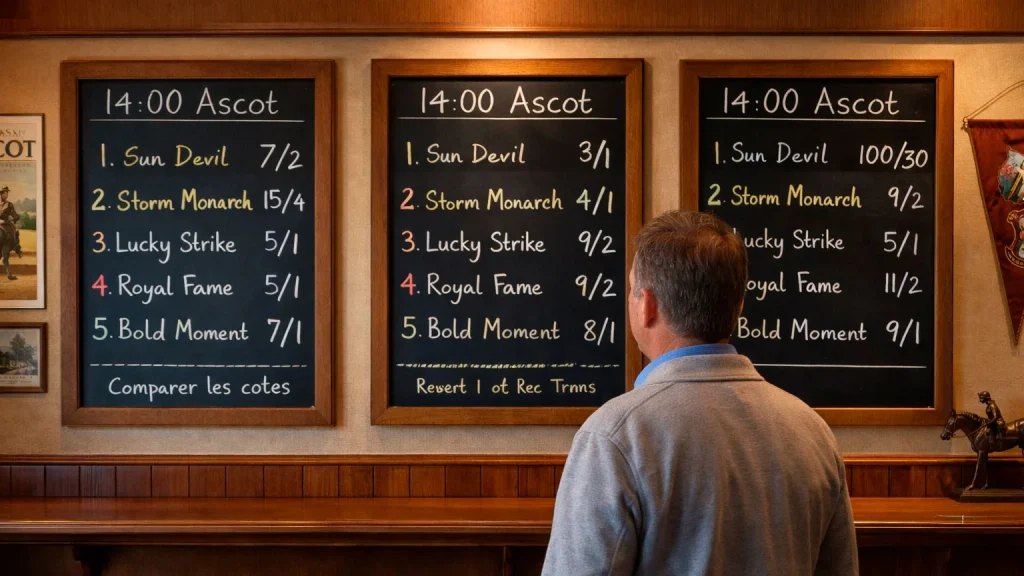
Ascot odds comparison represents one of the simplest yet most overlooked edges available to horse racing bettors. Different bookmakers offer different prices on the same horse in the same race—sometimes by significant margins. Taking 5/1 when 6/1 is available elsewhere costs you money on every winning bet. Across hundreds of bets over a season, these small differences compound into substantial sums. Finding the best price is not optional for serious punters; it is fundamental.
This guide explains why odds differ between bookmakers, how to exploit those differences systematically, and which tools make the process efficient. Whether you are backing one horse per week or betting actively throughout a race day, the principles remain the same: never accept a worse price than you need to.
Why Odds Differ Between Bookmakers
Bookmakers set odds to balance their books—attracting bets on all outcomes while building in a margin that guarantees profit over time. This margin, known as the overround, varies by operator, by race, and by time of day. A bookmaker offering tight margins on feature races might widen them on afternoon handicaps; another might take the opposite approach. These structural differences create persistent price variations.
Money flow also moves prices independently at each bookmaker. If one operator attracts heavy support for a particular horse, it will shorten that horse’s price while others—who have not seen the same action—maintain longer odds. Professional bettors exploit these windows before prices converge, but even recreational punters benefit by checking multiple sources before placing their bet.
The scale of the industry explains why price competition matters. According to the HBLB’s Annual Report, expenditure supporting British racing reached £94.3 million in 2024/25, funded through the betting levy system. This investment reflects a market worth billions in annual turnover—a market where even fractional price improvements translate to real money for bettors who shop around.
Competition between bookmakers benefits consumers. Each operator wants your business, so they compete on odds, bonuses, and features like Best Odds Guaranteed. Recognising this dynamic positions you to extract maximum value: use their competition to your advantage rather than defaulting to a single account out of convenience.
Best Odds Guaranteed Explained
Best Odds Guaranteed (BOG) is a promotion that protects you from taking a price that subsequently drifts. If you back a horse at 4/1 and it starts at 6/1, BOG means you receive the better starting price regardless of the odds you originally took. The policy effectively eliminates the risk of early betting, allowing you to lock in good prices without fear of missing a later improvement.
Most major bookmakers offer BOG on UK and Irish horse racing, though the terms vary. Some apply BOG to all races, while others restrict it to specific meetings or times. Maximum payout limits may cap how much you can win at enhanced odds. Read the terms before assuming you are covered: a headline BOG offer that excludes major handicaps or applies only to the first race of your day offers less protection than it appears.
Timing your bets around BOG policies requires some thought. If your bookmaker offers unrestricted BOG, you can bet early to secure current prices with full protection if the starting price improves. If BOG has limitations, you might wait closer to race time when prices are more stable, reducing the chance of significant drift but also missing any early value. There is no single correct approach; understanding the specific terms of your bookmaker’s offer guides your decision.
BOG interacts with odds comparison in important ways. If two bookmakers show the same price but only one offers BOG, the BOG bookmaker is objectively better: you get the same current odds plus free upside if the price drifts. Factor BOG availability into your assessment when prices are similar across operators.
Comparison Tools and Services
Manual odds comparison—opening multiple bookmaker sites and checking prices individually—is time-consuming and impractical during busy race days. Odds comparison tools aggregate prices from dozens of bookmakers into a single interface, highlighting the best available odds instantly. Oddschecker is the dominant UK service, covering horse racing alongside other sports and offering features like price alerts and historical odds tracking.
Using comparison tools effectively requires understanding their limitations. Prices update in near real-time but lag slightly behind live markets; a quoted price may have shortened by the time you place your bet. Some bookmakers are not included on every comparison site, meaning the “best odds” displayed might not truly be the best available. Treat comparison tools as starting points for your search rather than definitive sources.
Industry trends affect how valuable odds shopping has become. The HBLB reports that average betting turnover per race has fallen approximately 8 percent year on year, continuing a pattern that has seen reductions of 15 percent and 19 percent in prior years. This declining turnover environment puts pressure on bookmaker margins, leading to more competitive pricing on racing as operators fight for a share of shrinking volumes. Bettors benefit from this competition—but only if they actively exploit it through comparison.
Mobile apps from comparison services enable line shopping at the track or on the sofa. Checking odds seconds before placing a bet ensures you are not missing value available elsewhere. The extra few seconds required to verify best price becomes habitual with practice, eventually requiring no conscious effort at all.
Systematic Line Shopping
Serious bettors treat odds comparison as non-negotiable practice rather than occasional activity. This requires maintaining accounts with multiple bookmakers—at minimum four or five of the major operators—so you can actually access the best price when you find it. Having accounts in place before you need them eliminates the friction of signing up mid-race day, when time pressure might lead you to accept inferior odds.
Account management across multiple bookmakers involves some administration but pays dividends. Keep balances modest in each account, topping up as needed rather than leaving large sums idle. Take advantage of welcome offers when opening new accounts, extracting initial value before settling into regular use. Monitor each bookmaker for account restrictions; operators sometimes limit successful customers, reducing stakes or removing BOG eligibility.
Tracking your betting activity reveals how much line shopping saves over time. Recording the price you took alongside the price available elsewhere quantifies the benefit. If you regularly find yourself taking odds that are one or two points shorter than the best available, the cumulative cost becomes visible—and motivating. Even bettors who break even on selections can lose money overall by consistently accepting worse prices.
Discipline matters more than perfection. You will not always find the absolute best price; markets move, and sometimes another bookmaker’s odds shorten before you can bet. The goal is to consistently capture better-than-average prices, not to achieve theoretical perfection on every bet. Over time, this marginal edge compounds into meaningful profit that distinguishes successful bettors from those who wonder why their form study never translates to returns.
Integrating odds comparison into your betting routine takes practice. Initially, checking multiple sites feels slow and cumbersome. Within weeks, it becomes automatic—you check prices before betting just as you check form before selecting. The habit formation phase requires conscious effort, but the long-term payoff justifies the initial investment of attention.
When you consistently shop for the best price, you effectively increase your strike rate’s profitability without changing your selections at all. A 20 percent strike rate at average odds of 5/1 produces different returns than the same strike rate at average odds of 5.5/1. That half-point difference, achieved simply by taking the best available price rather than accepting whatever your usual bookmaker offers, turns marginal operations into profitable ones over sufficient sample sizes.